Balliol College

One of Oxford’s oldest and most intellectually influential colleges, known for its historic courtyards and strong academic tradition.
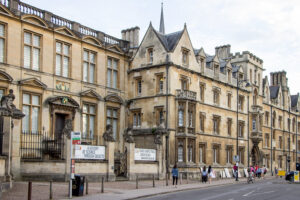
Oxford University - Balliol College. Image courtesy of Billy Wilson.

Balliol College is one of the oldest colleges in Oxford. It’s centrally located, opposite the Ashmolean Museum. Many well-known Prime Ministers have studied at Balliol, which is also the house of Adam Smith, Aldous Huxley, and Richard Dawkins. Bill Clinton briefly visited Balliol College to study Politics, Philosophy, and Economics at the University (although he didn’t finish his degree). 

The History of Balliol College

Balliol College was founded in 1263 y John I of Balliol, a landowner from Barnard Castle in County Durham. It’s said that the founder abducted a bishop after a dispute over land and forced him to support a group of Oxford scholars – thus, Balliol College was born. When John I died, his widow Dervoguilla continued his work, providing more endowments and writing the statutes (reason why she’s considered a co-founder today).

Balliol College Buildings and Gardens

The College has two Quadrangles: one at the front of the building (“Front Quadrangle”), and the other in the garden (“Garden Quadrangle”). The oldest parts of the college are the north and west ranges, which date to 1431. Balliol College’s second library pre-dates the publication of printed books in Europe. The dining hall was built in 1877 and replaced an older hall that had become too small for the college’s population. The hall is built in geometric style, using Bath stone and Tisbury stone. The roof and roof work are made of oak. The hall was designed by Alfred Waterhouse. The Tower forming the corner between the “Old Hall” and “Old Library” was made by Salvin in 1853. The college also contains a bar and a shop.

Balliol College Image Gallery

Dining Hall, Balliol College, Oxford. Image courtesy of Randy Connolly via Flickr Commons.
Oxford University - Balliol College in the Winter. Image courtesy of Piers Nye via Flickr Commons.
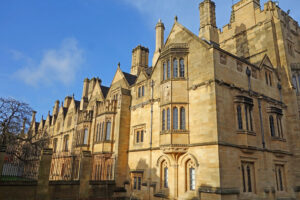
Oxford University - Balliol College. Image courtesy of Billy Wilson.
Oxford University - Balliol College. Image courtesy of Billy Wilson via Flickr Commons.
Oxford University - Balliol College Windows. Image courtesy of Don Brubacher via Flickr Commons.
Oxford University - Balliol College Gardens. Image courtesy of Randy Connolly via Flickr Commons.
Oxford University - Balliol College Chapel. Image courtesy of Pjposullivan1 via Flickr Commons.

What it's Like to Study at Balliol College and Balliol Customs

The college provides its students with accommodation, a hall, library, two bars, and common rooms for fellows, graduates and undergraduates. Balliol has evolved its traditions and custos over the centuries. The patron saint of the college is Saint Catherine of Alexandria, a Christian saint martyred in the early 4th century. Her feast is 25 November, when a formal dinner is held for all final year students (this festival was established by 1550). Other feasts are the Snell Dinner (named after John Snell, a benefactor of the College), the Christmas Dinner in Michaelmas, Burns Night in Hilary, and the May Dinner in Trinity term (learn more about Oxford University’s terms here).

The most eccentric event, however, is The Nepotists carol-singing, organised by the college’s Arnold and Brackenbury Society. Balliol students congregate in the college hall on the last Friday of Michaelmas term to enjoy mulled wine and the singing of carols.

Balliol hosts the famous Oxford University Tortoise fair and race, in which the college pets compete to be the fist to reach a circle of lettuce. Because of Balliol’s historical left-learning affiliations, the tortoises are usually named after famous Marxists.

Where is Balliol College?

Balliol College is located in Oxford city centre: Broad Street (OX1 3BJ). The east side of the quad is a neighbouring wall with Trinity College.

Balliol College Coat Of Arms
Arms: Azure, a lion rampant argent, crowned or, impaling Gules, an orle argent.

Can you Visit Balliol College?

Yes, Balliol College is open to the public. 

  • Open: Usually open 10.00-17.00 or dusk (whichever is earlier).
  • Charge: Adults from £3, concessions and students from £1.
  • Groups: Maximum 15 people in a group.

Related to Balliol College

There is a traditional and fierce rivalry between the students of Balliol and those of its immediate neighbour to the east, Trinity College. This takes the form of songs, “raids” on the other college, and sports, in particular regattas and races.

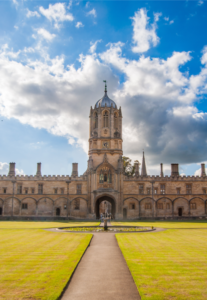
Oxford University Trinity College. Image courtesy of Dave_S.

Trinity College

A peaceful and picturesque college celebrated for its immaculate lawns and quiet elegance.

Balliol College is located opposite the Ashmolean Museum

Iconic Oxford Colleges

Oxford’s unique structure comprises a collection of colleges, each with its own distinct personality and history. From the storied halls of Christ Church to the intimate charm of Magdalen, exploring these collegiate enclaves offers a glimpse into the daily lives of scholars past and present. Many colleges welcome visitors to stroll through their gardens, chapels, and dining halls.

Oxford University - Balliol College. Image courtesy of Billy Wilson.

Balliol College

One of Oxford’s oldest and most intellectually influential colleges, known for its historic courtyards and strong academic tradition.

Explore »
Oxford University - Exeter College. Image courtesy of Billy Wilson.

Exeter College

A historic city-centre college known for its striking chapel, lively student life, and atmospheric medieval architecture.

Explore »
Oxford Colleges - Keble College. Image courtesy of David Nicholls.

Keble College

Instantly recognizable for its bold Victorian architecture and expansive grounds, Keble offers one of Oxford’s most distinctive settings.

Explore »

Explore Oxford’s most iconic architecture.

Step into centuries of tradition and history.

Uncover fascinating collections and stories.

Churches

Discover Oxford’s beautiful churches.

‭→ 

Explore world-famous libraries and reading rooms.

Find Oxford’s best-kept secrets and quiet corners.