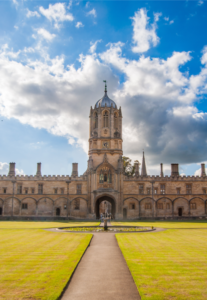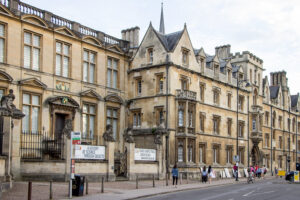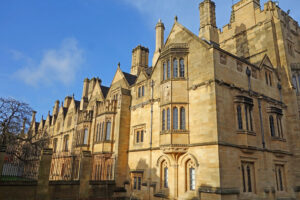

One of the constituent colleges of the University of Oxford, St Hugh’s College is situated on St Margaret’s Road, north of the city centre. It was founded in 1886 by Elizabeth Wordsworth as a women’s college; in 1986, it accepted its first male students. With its extensive gardens, it is considered one of the most attractive colleges.
As of July 2018, St Hugh’s College’s financial endowment stood at 37.6 million, making it one of the most endowed colleges in the UK. The college became a registered charity in its 125th anniversary year.
What's the History of St Hugh's College?
St Hugh’s College was founded in 1886 by Elizabeth Wordsworth and was initially a women’s college aimed to help the growing number of women “who find the charges of the present Halls at Oxford and Cambridge (even the most moderate) beyond their means“. Wordsworth used money left to her by her father, former Bishop of Lincoln, and established the new college at 25 Norham Road in North Oxford. She decided to name it after one of her father’s 13th-century predecessors, Hugh of Avalon.
Records show that rent for students was between £18 and £21 a term, depending on the size of the room, with fires being charged extra. The first lectures were arranged by the Association for the Education of Women, with the first college tutor being Dora Wylie, appointed circa 1898.
In 1913, the college began moving to its present site after purchasing a house called “The Mount” (the freehold was owned by University College). This house was later demolished to construct the main building between 1914 and 1916. The college soon also took over other properties nearby.
St Hugh's College and the Second World War
At the outbreak of the Second World War the college site was requisitioned by the military and used as the Hospital for Head Injuries. Brick huts were constructed on the grounds with space for 300 beds. Over 13,000 servicemen and women were treated at the college between 1940 and 1945, and advances in medicine discovered at this hospital decreased the mortality rate for brain-penetrating injuries from 90% to 9%.
After New College made a proposal for the admission of women to the men’s colleges in 1964, Lady Margaret Hall and St Anne’s College reciprocated by admitting men as undergraduates. St Hugh’s, which was already employing male lecturers, decided to admit men as Fellows. Coeducation wasn’t agreed until 1986.
Famous Alumni of St Hugh's College

Emily Wilding Davison
Emily Wilding Davison was an English suffragette and a member of the Women’s Social and Political Union (WSPU). She was arrested on nine occasions and went on hunger strike seven times. Emily studied at Royal Holloway College, London, and St Hugh’s College, Oxford, later becoming a governess.
The Buildings of St Hugh's College
St Hugh’s College occupies a rectangular site in North Oxford, bordered by Banbury Road to the east, Woodstock Road to the west, St Margaret’s Road to the north and Canterbury Road to the south. The gardens cover about ten and a half acres. The main entrance of the college is on the north and leads straight to the Main Building, which accommodates first-year students and houses the chapel and the dining hall.
Second years live in either the Rachel Trickett Building or the Mary Gray Allen Building. Finalists usually live in the newer Maplethorpe Building,whose rooms have en-suite facilities.
What is it Like to Study at St Hugh's College, Oxford?
The college accommodates all its undergraduates for the duration of their studies. There are three large lawns and the gardens are also the venue for croquet. St Hugh’s has a wide range of clubs and societies such as sporting, academic, and those supporting niche interests like horticulture.
The college has Formal Hall (three or four course dinner and wine) once a week. Grace is said by the presiding fellow, usually the principal, immediately prior to the meal: Benedic nobis, Domine Deus, et his donis, quae ex liberalitate Tua sumpturi sumus, per Jesum Christum Dominum nostrum. Amen. St. Hugh’s also has a choir that sings weekly evensong on Sundays.
The undergraduate body is represented by a committee called the JCR Committee. ‘JCR’ also refers to the physical common room in the college. There is also a Middle Common Room Commitee elected every year.
Where is St Hugh’s College?
St Hugh’s College is located on St Margaret’s Road (OX2 6LE), Oxford. Tel 01865 274900.

Can you Visit St Hugh’s College?
Yes, St Hugh’s College is open to the public.
- Open: Please check in advance.
- Charge: Free, donations welcome.
- Groups: Check in advance.